Sunday, February 12, 2012

World War I Era Communication Technology


   In our history class we started studying World War I. For this project I am writing about the communication technology used during the World War I era. At this time many breakthroughs in technology occurred. During the war, the military needed the fastest way to communicate possible. They started using anyway they could, whether it was airplanes or telegrams.

                                        http://www.corp.att.com/attlabs/images/history0106.jpg
   During the period of the war, airplanes just came around. I found, by reading World War I Primary Sources, that because airplanes were so basic they were mostly used for scouting and delivering messages. They were used much differently then we use them today, for fighting. In a letter I found in the  book, a pilot says he just received his first duty, to take photographs of the enemy's second-line trenches. He also says that the plane he was using, the BE2c, was a plane that was unsuited for the job.
http://upload.wikimedia.org/wikipedia/commons/6/6b/Avro_BE2C_ExCC.jpg
    I wanted to find out about the other way airplanes were used during the war era, for messengers. The pilots of the airplanes had to either land, or drop the messages from their airplanes. This posed a problem because it made the process of delivering messages very difficult. Later they started making progress in using tele-communications in the planes. Towards the end of the war, a lot of the planes used for messengers had radios in them.
http://www.afhra.af.mil/shared/media/photodb/web/080129-f-3927s-242.jpg

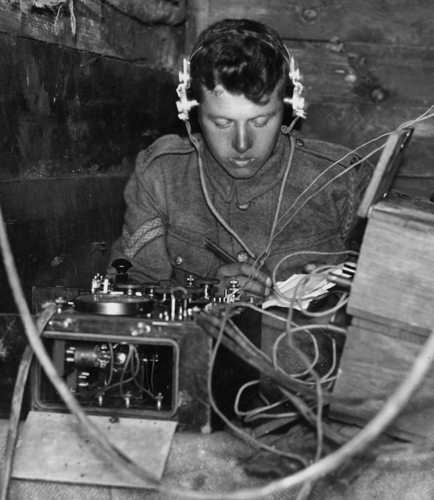
    The radio was one of the earliest forms communication that uses electrical signaling. When I read an article from 1919, i found it interesting that they thought the wireless radio telephone will never out-do the wired telephone. During the 1914s many experiments were conducted to try and create a radio telephone, none of these succeeded. One problem with radio communication was at the time, they were non-secret. Anyone was able to listen in on the conversation, even enemies of war!
http://rpmedia.ask.com/ts?u=/wikipedia/commons/thumb/8/85/Marconi_Type_106_crystal_radio_receiver.jpg/100px-Marconi_Type_106_crystal_radio_receiver.jpg
            
    Although radios played a huge role in the war, they also changed things back home in the US. After researching I found out radios were used for many different things. During this time period there were accounts of soldiers transmitting songs for entertainment during the war. Back in the US people also used radio broadcasts to promote the war. The U.S.S. George Washington, in 1919, played concerts on it's radio to the passengers. 
http://www.mhs.ox.ac.uk/marconi/exhibition/images/In%20the%20trenches%20sml.jpg
                                                                                                                                          
     Another important source of communication during the war was the telegram. I knew that the telegram played a big role during the war, but i did not know how big it was. The most famous use of this technology is arguably one of the reasons the US got involved in the war, the Zimmerman Telegram. The German foreign secretary Arthur Zimmerman sent a telegram to Mexico, promising lost territories that belonged to the United States if they joined the German side. President Wilson released the telegram to the press, completely changing the public opinion to become against the Germans. This helped make the decision easier for the United states to enter World War I. 
http://www.archives.gov/education/lessons/zimmermann/images/decoded-message-m.jpg


Tuesday, January 31, 2012

WWI research

For my research I read a letter written by Robi Wilcock. In the letter it describes the author researching Private Walter Goodwill. Private Goodwill was part of the 281 Scottish Constitution and the 1931 Enlgish Constitution. Walter was around the age of 32 during the war. Walter Goodwill was killed on 3/9/1916 during battle in France.

Tuesday, January 17, 2012

Day 3 research

I am finding new pictures for my project. one is the ship. Another is the sailors jumping off into the water. I researched the visiting of Chile,  Virginia, Italy, Japan, and Christmas festivities.

Friday, January 13, 2012

Great White Fleet Research: Day 2

So far for my research on Day 2 i have used the wonderful source of Alabama Virtual Library to find a source on the Great White Fleet visiting Australia. I have also found more pictures, one includes a very colorful ship that made the journey with the fleet. Another picture i have found shows the journey that the Great White Fleet made. Using the Alabama virtual library i found another source talking about a storm that the Great White Fleet encountered during it's voyage. Some more pictures include the fleet entering a harbor and the fleet passing through a beautiful mountain range.

Thursday, January 12, 2012

The Great White Fleet research. Day 1:

So far in my research i have started to look for good primary sources and pictures for my postcard templates. Some of the pictures i have found include a couple of ships and Teddy Roosevelt . I have also found a good primary source using the library of congress digital archive. This source shows an advertisement for the Great White Fleet in the New York Tribune.

Monday, November 7, 2011

Football from 1880-1920

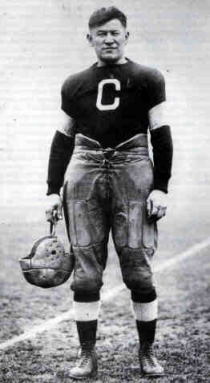
From the years of 1880-1920 football started rising in popularity. It was no longer a small sport, it was now rising into one of America's prime entertainment activities. One person that helped market the relatively new sport of football was Walter Camp. Walter Camp used savvy marketing and his many publications about football to increase the popularity of the sport. Another person who helped increase football's popularity was Jim Thorpe. Jim Thorpe was football's first real star. Americans were very eager to see Jim Thorpe play.

In the Early days of football it was very popular on the collegiate level. The very first game played was Princeton vs. Rutgers in 1869. Rutgers defeated Princeton 6-4. After this game college football's popularity sparked. All across the country schools were starting their football programs. Some schools like Michigan, Notre Dame, Army, and Harvard had dominant teams. Michigan was considered the first dominant team in the West, winning the national championship from every year from 1901-1904.

Although collegiate football was growing in popularity it still had it's problems. In the season of 1905 18 college football players were killed while playing in a game. A committee met to address the problem and decided to institute new rules to lower the chances of injuries and fatalities. They introduced new rules like the forward pass as an alternative to just running the ball. The reason players were being hurt in games was because both teams would line up in a "wedge" formation. This formation consisted of both teams lined up in a "V" shape and run at each other.They also made the neutral zone and made it so first downs required 10 yards, up from 5.


In early college football there was no postseason play. But in the year 1901 James Wagner was elected as the president of the Tournament of Roses. James new that they were having trouble attracted a crowd so he came up with the idea to put on a postseason football game. He wanted Michigan and California to play but California refused, so Stanford took their place. The first postseason game was a huge success that gathered around 8,000 fans. The next Tournament of Roses game took place in 1916 when Washington State defeated Brown. After this many other cities started organizing postseason games too, creating the bowl game system.
During the early stages of football collegiate play was the most popular. But soon professional football started to rise. People thought that professional football would bring more excitement to fans. People also knew that many college football stars became unknown, so adding a professional league would bring them back into the spotlight. The selling point behind professional football was that it was going to be a gridiron battle between two teams full of All-American All stars.

. Dayton Triangles

Another research update

In my research I now have almost all of my sources. I am just missing one primary source and a couple pictures. I have learned a lot about how football has affected people of the time.